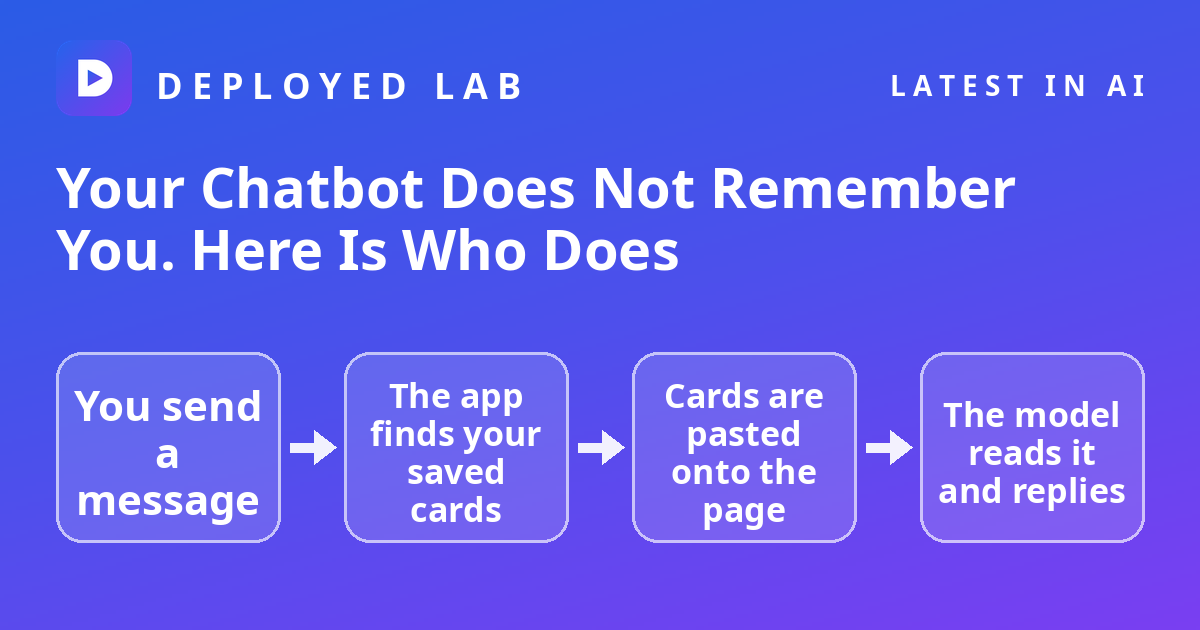
It greets you by name. It mentions your last order, your dog, the trip you are planning. It feels like your chatbot remembers you. It does not. The AI model underneath forgets everything the moment each chat ends, and what you are seeing is a notebook the app keeps about you, read back to the model before it answers.
A language model is stateless, which means it keeps nothing from one chat to the next. Chapter 14 of the Deployed Lab course puts it plainly: the model is like a calculator that clears itself after every sum, or a very capable stranger who is handed one page, answers it, and forgets everything when you leave. Each time you write, the model sees only the page of text in front of it: the rules, some notes, and your message. If a fact is not on that page, it does not exist for the model.
So who does remember? The software around the model. Think of a helpful shop assistant with a bad memory and a good habit. While you talk, they keep a small pad on the desk with what you just said. That pad is short-term memory, and it stops being copied onto the page when you leave. If something matters, they write it on a card and file it in a drawer: long-term memory. A card might say, "Kavish prefers email, not phone." Next visit, before you speak, they pull your card out and read it. Your chatbot's app does the same thing in code: it saves cards about you, searches them when you write again, and pastes the matching ones onto the page the model is about to read.
Why it matters
The model only ever knows what was saved, and saved cards can be wrong. In the chapter's example, a customer named Kavish moved house and changed jobs, but the drawer still held his old address, so the assistant kept sending things there. A card with no expiry date turns into a confident wrong answer. The fix starts with you: most chat apps let you view the notes saved about you, edit what is wrong, and delete what should not be kept. And if you ever ask the model itself to forget you, know that it cannot. It never held the memory. Deleting the saved cards is what forgetting actually means.
Source: this story teaches from Chapter 14, Memory systems, of the Deployed Lab course.
Chapter 14 goes further: what to save and what to never save, how to spend a limited memory budget, and how to delete one person's data everywhere it was copied. The full interactive course, 11 chapters free, no signup, is at deployedlab.dev.