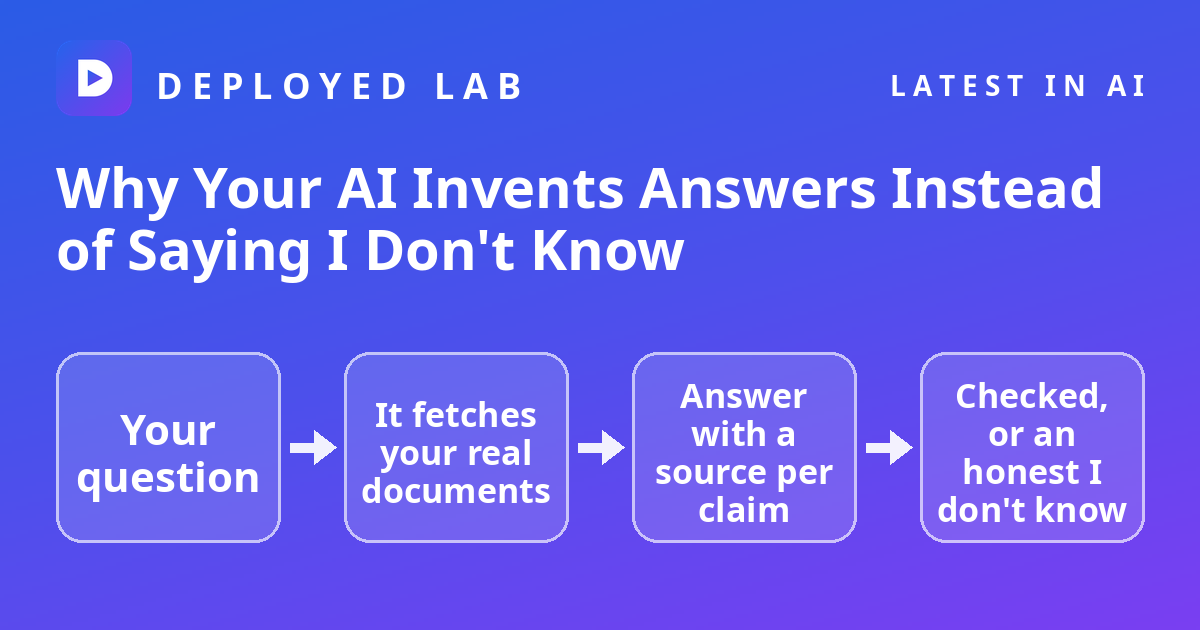
Ask an AI a question it cannot answer and it rarely stays silent. It writes a fluent, confident reply, complete with numbers, names, and citations. Some of those citations do not exist. The answer was never looked up, because looking things up is not what the AI does.
A language model is, at heart, phone autocomplete trained on a mountain of text. It learned what good answers look like, and it writes by predicting the words that sound right next. It did not store a tidy list of facts, and it has no built-in check that a statement is true. So when the facts are missing, plausible text still comes out, in exactly the same calm voice as its correct answers. That confident, unsupported output is called a hallucination. Picture a student in an exam who did not study: rather than leave the page blank, they write a neat, confident guess, and invent a section number to cite. The model is that student, on every question, all day.
Chapter 15 of the Deployed Lab course names four kinds you will meet. Fabricated facts: a number, name, or rule that appears in no source. Wrong or invented citations: a real-looking reference that does not exist, or a real document that does not say what is claimed. Unsupported inference: a conclusion that runs ahead of what the sources allow. And contradiction: a claim that says the opposite of its source. In the chapter's worked example, an answer about a leave policy makes six claims. Three are supported. One cites the wrong source, one is invented from nothing, and one contradicts the policy outright. Three of six means the answer is 50 percent faithful, and it reads smoothly from start to finish. Nothing in the writing style tells you which half to trust.
Why it matters
The fix is not a better memory test. It is an open-book exam. Grounding means the system fetches passages from your real documents first, the model answers only from those passages, every claim carries a citation a reader can click, and a separate check compares each claim against its passage. Anything unsupported becomes an honest "I could not find this in the documents" instead of a confident guess. A graceful refusal is a feature, because a wrong answer costs more than a missing one. Until every tool you use works this way, one habit protects you today: for anything that matters, ask for the source, and click it. A citation on its own proves nothing.
Source: this story teaches from Chapter 15, Hallucinations and grounding, of the Deployed Lab course.
Chapter 15 goes further: the four kinds of wrong, a claim-checking exercise, and how to score any answer for faithfulness yourself. The full interactive course, 11 chapters free, no signup, is at deployedlab.dev.