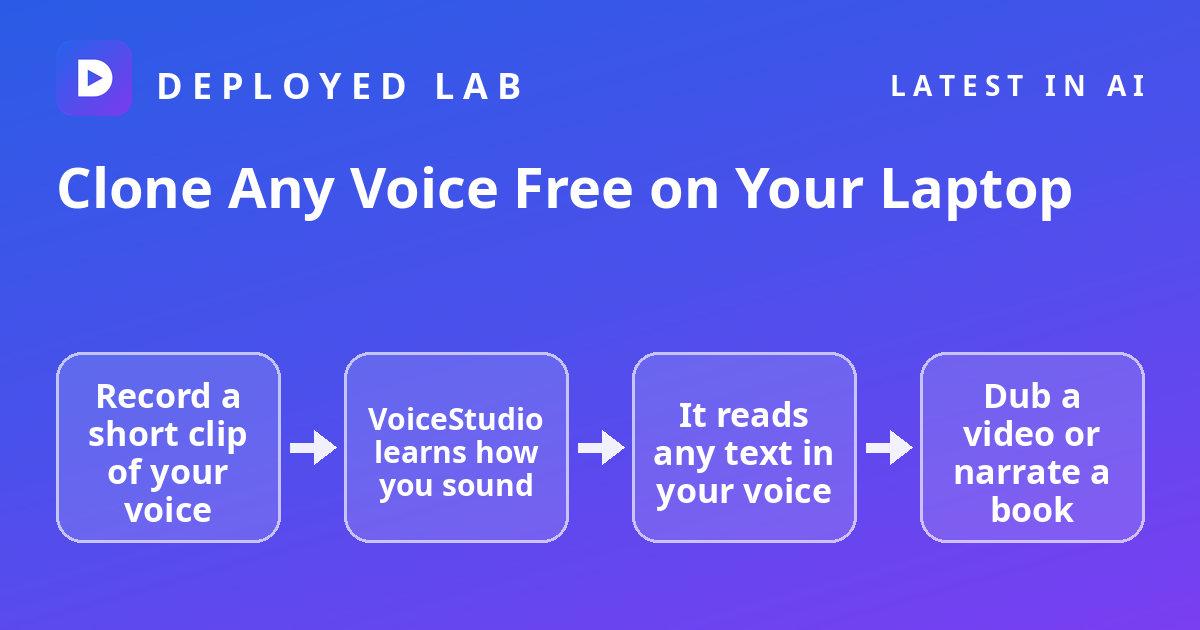
Voice cloning used to mean uploading your recordings to someone else's server and paying by the minute. VoiceStudio moves the whole studio onto your own laptop. It is free, it needs no account, and with 117,753 stars on GitHub it is one of the most popular voice tools in the world.
Here is what it does. Give it a short, clean recording of a voice and it learns how that voice sounds, then reads any text you type in it. Point it at a video and it dubs the speech into other languages, timed to the original, drawing on a catalogue of 646 languages. Give it a book or a script and it narrates the whole thing as an audiobook. It can also design a voice from a written description, take dictation, and transcribe recordings. Under the lid it bundles many speech engines and lets you download only the models you need, so a small job can run on a modest machine and a bigger job can use a graphics card if you have one.
The reason it can be free is where it runs: on your hardware. There is a normal installer for macOS on Apple Silicon, Windows 10 and 11, and Linux, plus a Docker option. Nothing you record is uploaded, because there is no cloud in the loop, and the code is open source under the AGPL-3.0 licence. Two honest catches. The voice models live on your machine, so the downloads are chunky, in some cases several gigabytes. And while the app itself allows commercial use under its licence, the default voice model's weights are non-commercial, so check the licence in the app's Model Manager before using a cloned voice for paid client work. Paid Pro and Cloud extras exist, but everything described here is in the free app.
Why it matters
A voice is personal data. Sending recordings of your voice, your family's voices, or your customers' calls to a cloud service means trusting that company with something you cannot change like a password. A local tool flips the default: the recording never leaves the room, and the cost drops to the electricity your laptop was using anyway. For creators it means dubbing a video for a new audience without a studio bill. For everyone else it means a bedtime story in your own voice, an audiobook of your own writing, or a voiceover you can redo at midnight without a subscription counting down. The skill underneath is the one this whole field runs on: knowing what a model does with your data, and choosing where it runs.
Sources: the VoiceStudio repository on GitHub (stars, forks, license, features and platforms read on November 24, 2026) and dev.to on VoiceStudio's local-first design.
Voice tools like this are models, data, and careful defaults working together, the same pieces the course teaches hands on. The full interactive course, 11 chapters free, no signup, is at deployedlab.dev.