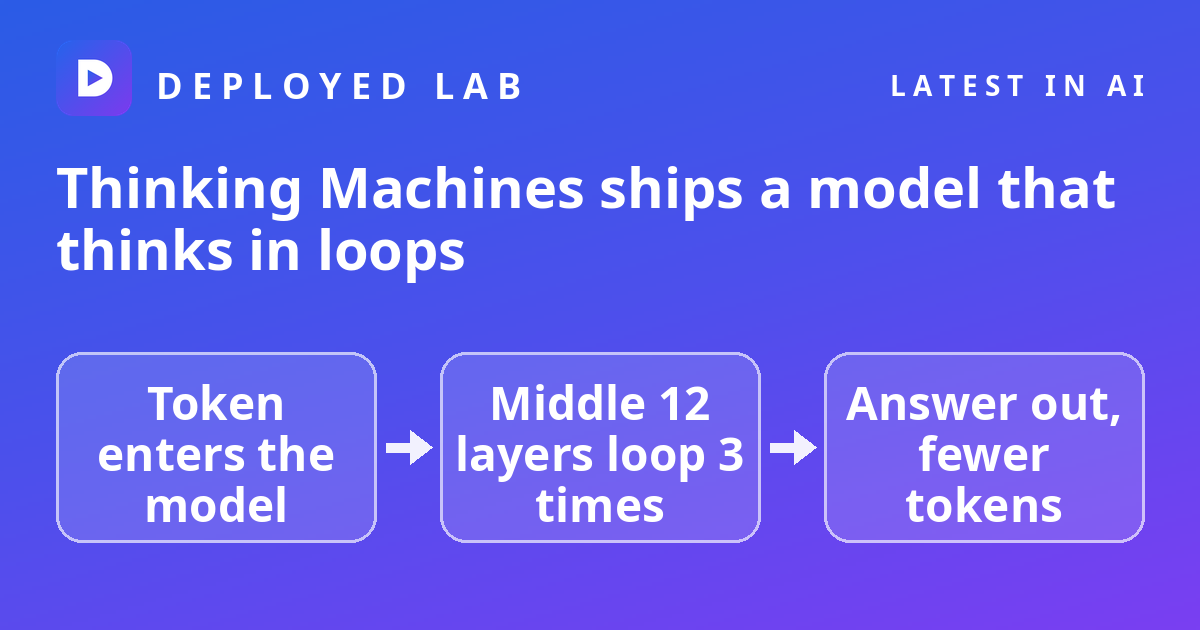
Thinking Machines released Inkling 2 Mini on November 20, and the interesting thing about it is not its size but how it uses the size it has. It is a 26.4-billion-parameter open-weights model that runs on a laptop, because it reuses its own layers instead of adding more of them.
The trick is looping. Inkling 2 Mini has 24 physical decoder layers, and the 12 middle layers run three times for every token, so each token makes 48 layer visits. It is a sparse Mixture-of-Experts design: only 3.4 billion parameters are active per token, 5.4 billion effective once the loops are counted. The checkpoint is about 20 gigabytes, and Thinking Machines says it runs on Apple silicon with at least 32 gigabytes of memory, on a single NVIDIA DGX Spark, or on GPUs with 32 gigabytes or more of VRAM. It takes text and images in, returns text, and carries a context window of up to one million tokens. The weights are open under Apache 2.0 on Hugging Face, with hosted inference and fine-tuning on Thinking Machines' Tinker platform. A research variant with a variable loop count was released alongside it.
On benchmarks, the model leads every open-weights model under 100 billion total parameters on agentic coding, according to Thinking Machines' own reported scores: 48.2 percent on DeepSWE v1.1, against 42.2 percent for Qwen3.8-27B, 79.2 percent on SWE-bench Verified, and 46.5 percent on the Vals Index v2.2, while agentic search reaches 79.0 percent on BrowseComp. These are vendor-reported numbers, not an independent verdict, but the pattern is consistent: coding, tool use and search are where this model earns its place.
Looping buys reasoning depth without adding factual knowledge, and the model trails comparable models on multi-turn dialogue and rule tracking. The deeper question is oversight. As the loop count rises, the model's written chain of thought gets shorter: in tests with the research variant, reasoning traces on GPQA Diamond fell from 3,703 tokens at one pass to 1,661 at five, while the model kept working for longer without writing anything down. That makes a looped model harder to monitor by reading its reasoning, the technique teams rely on today. Thinking Machines reports that sabotage scores did not trend higher as loops were added, but supervising models that reason inside their own loops is an open problem.
Why it matters
For an AI engineer, the practical shift is that serious coding agents no longer need a data centre. A 20-gigabyte model that beats larger open models on coding means an agent can run on the developer's own machine, offline, with code and data staying local and no per-token bill. That opens up local copilots, agents inside a company's own network, and tools for developers who cannot send code to a cloud API.
The judgement call is knowing where it stops being the right tool. Factual recall and multi-turn instruction following lag behind its coding scores, and a model that reasons inside a loop is harder to audit than one that shows its work. The skill is the same one production systems already need: pick the model for the job, measure it on your own tasks rather than the vendor's, and keep a human-readable trail where it counts. Looping just moved the frontier for what a laptop can do.
Sources: Thinking Machines' announcement and The Decoder's coverage.
Model choice, routing and cost control are a whole module of the course. The full interactive course, 11 chapters free, no signup, is at deployedlab.dev.