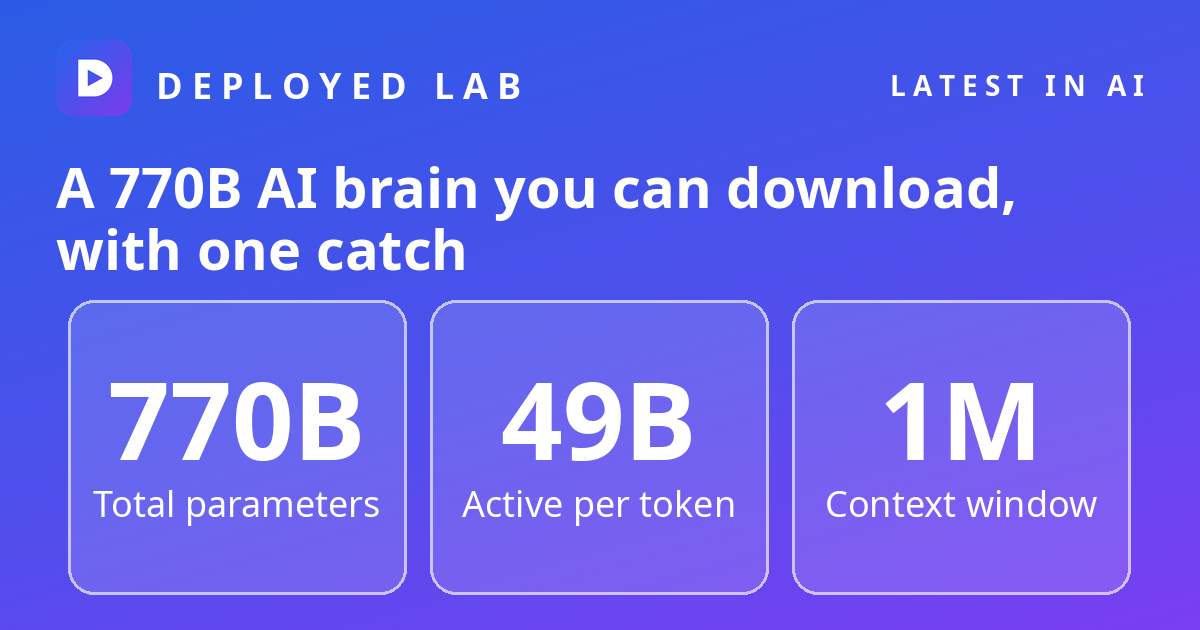
Tencent has published the full weights of Hy4, its flagship AI model, and the download is as big as the model: about 1.55 terabytes. The November 20 release puts a 770-billion-parameter model with a million-token context in the hands of anyone with a multi-GPU server.
Hy4 is a mixture-of-experts design: 770 billion total parameters, with 49 billion active for each token, spread across 78 layers, with eight of 256 routed experts firing per token. It is natively multimodal, reading text, images and video through a 1.23-billion-parameter vision encoder, and it is the first model in Tencent's Hunyuan line that can operate a computer through command-line and graphical interfaces, with targeted training for tools like Blender and CAD and game engines like Unreal and Unity.
What landed on November 20 is the full set: the instruct model, an FP8 build at about 790 GB, and the pre-trained base model, on Hugging Face, ModelScope and GitCode, with a system card. Serving recipes are published for vLLM and SGLang, with an eight-GPU tensor-parallel setup as the recommended serving unit. Until now Hy4 was API only, since its November 4 launch, at $0.834 per million input tokens and $2.501 per million output tokens.
The catch is the license. Hy4 does not ship under the plain Apache 2.0 of Tencent's earlier Hy models. It uses the Tencent Hy License, derived from Apache 2.0, and section 10 requires a separate written license from Tencent for anyone selling Hy4 inference as a service above $50 million in yearly revenue, or 100 million monthly users. Purely internal use is exempt, and below those lines the weights are free to download and run. It is a line every team planning to host the model commercially has to read first.
Why it matters
For engineers, this is the largest open-weight flagship you can actually download and run yourself, with computer use and a million-token context in the same package. That combination matters for agent work: a model that can read a screen, hold a huge working context, and run on your own infrastructure suits teams that cannot send data to a hosted API. But the serving cost is a datacenter decision, not a laptop one: the FP8 checkpoint alone is about 790 GB of weights before any KV cache, so eight H200 or B200 class cards is the realistic serving unit.
One caution on the numbers. Every benchmark on the model card is Tencent's own evaluation: the base model scores 91.6 on MMLU and 73.9 on MMLU-Pro in its tables, ahead of the DeepSeek baselines it lists. The card is candid that a gap remains to the top proprietary models on research-level maths, long-horizon coding and advanced visual question answering. Treat the scores as the maker's measurements, not independent results, and test the model on your own workload before committing hardware to it.
Sources: the Hy4 model card on Hugging Face and GPUJournal's coverage of the weight release.
Model choice, routing and cost control are a whole module of the course. The full interactive course, 11 chapters free, no signup, is at deployedlab.dev.