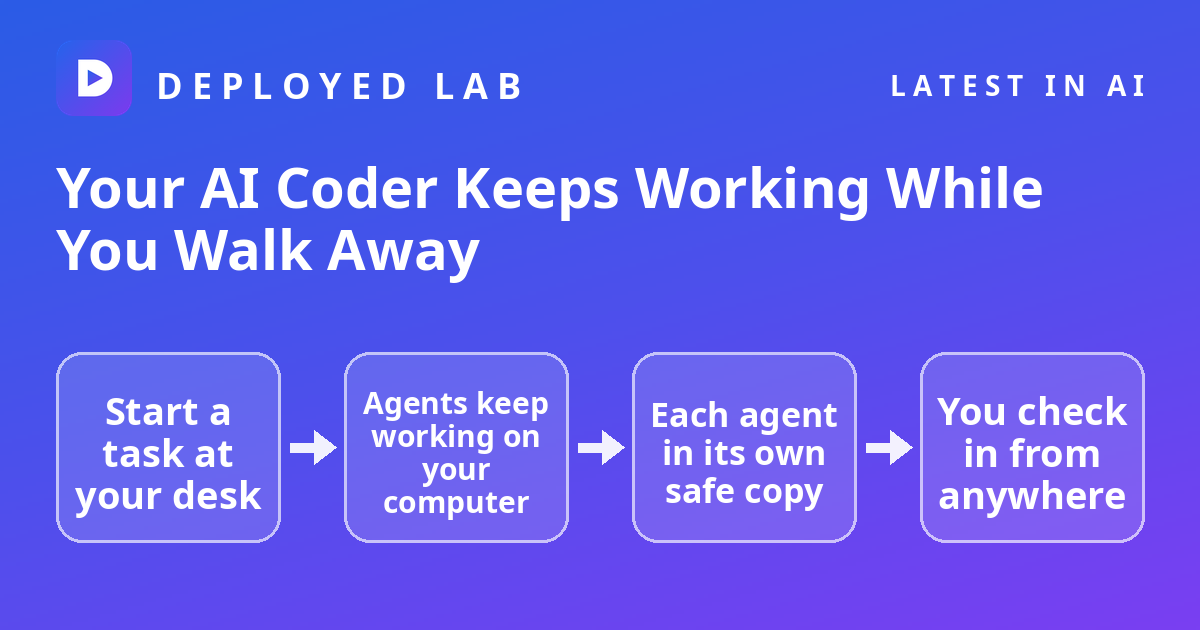
AI coding agents have a leash problem: they work on your computer, so you sit there watching them. T3 Code cuts the leash. It is a free, open-source app that puts the coding agents already installed on your machine, Claude Code, Codex, Cursor and more, behind one control screen you can open from your desk, a browser, or your phone. Over 80,000 people have starred it on GitHub.
Here is how it works. T3 Code runs a small server on your computer and starts the official agent tools you already have installed and signed in to. Each job, called a thread, can work in its own copy of your project, so several agents can work in parallel without stepping on each other. You can even switch models mid-task, or let one agent hand work to another. Because the agents run on your machine, your code never leaves it, and T3 Code sells you nothing: no tokens, no new subscription, just your existing accounts driven from a better screen. From the phone app, the full loop works: check progress, answer the agent's questions, approve a command, review the changes, and merge the finished work with one button.
Getting started takes minutes. Download the desktop app for macOS, Windows or Linux, install it with a package manager, or run one command for the command-line version; there is even a try-it-once option that installs nothing permanently. Then sign in to one agent you already have, for example Claude Code or Codex, and you are set. The phone connects over your home network, Tailscale, or the project's own T3 Connect route.
Why it matters
The interesting shift is not a smarter model. It is where the human sits. Until now, using a coding agent meant staying at the machine doing babysitting duty: watching, approving, unblocking. A control screen on your phone turns that into background work, the way email moved from the office desk to your pocket. It also shows where the value in AI tooling is moving: the models are rented by the month, but the workflow around them, orchestrating several agents at once and supervising them from anywhere, is being built in the open, for free. The honest limits are worth knowing: T3 Code brings no AI of its own, so your Claude Code or Codex bill stays yours, your computer has to stay on and awake while agents work, and the project is young, so expect rough edges.
Sources: the T3 Code repository on GitHub (stars, forks, MIT licence, README and install steps read on November 26, 2026) and Paralect's T3 Code overview.
Running several agents at once, each in its own workspace, with a human approving the risky steps, is agent orchestration, one of the core skills the course teaches hands on. The full interactive course, 11 chapters free, no signup, is at deployedlab.dev.