You and your coworker use the same AI. Her answers come back sharp and ready to send. Yours come back vague, too long, or quietly wrong. It is tempting to blame the model, or to assume she has a better tool. She does not. She has a better brief. A prompt is a note for a new employee, and the quality of the note decides the quality of the work.
Chapter 10 of the Deployed Lab course starts with that picture. You hire someone for their first day at the help desk, but you cannot sit next to them, so you leave a note. The note is the prompt; the new employee is the AI model. It follows the note as best it understands it, for every customer. A vague note ("be helpful, keep answers short") gets you a different result each time, because nobody, human or model, can be checked against it. A recipe card works better: numbered steps, exact amounts, and a picture of the finished dish.
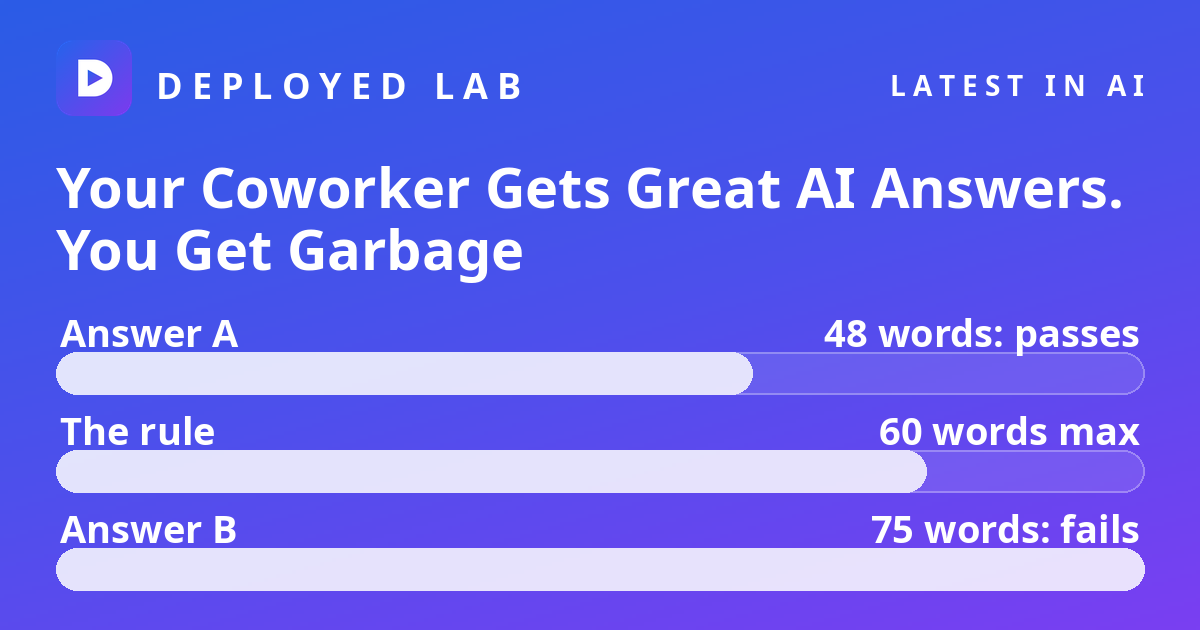
The chapter's recipe card for a support assistant reads like this. Use only the policy text. If the policy does not say, reply exactly: "I could not find that." Keep answers to at most 60 words. Reply as JSON, the strict labelled layout a computer can read. Then add one finished example of exactly the answer you want. Every line of that card can be checked, most of them by a script. "Keep answers short" cannot be checked; "at most 60 words" can. An answer of 48 words passes the rule. An answer of 75 words fails it, and you know it before a customer ever sees it.
Why it matters
Vague instructions do not just give you mediocre answers. In the chapter's opening story, a support assistant worked well in the demo, until someone edited its instructions to ask for a friendlier tone and wrote the change down nowhere. The next day the model started adding chatty text around its JSON replies, and the ticketing system that reads those replies rejected them. Nobody could say which edit did it. The fix is the same recipe card, plus one habit: treat the prompt like something you test. The chapter keeps a fixed list of test questions, each with a rule the answer must satisfy, and runs it after every change, because a friendlier prompt can quietly break three kinds of questions while it fixes four others.
So before you blame the AI, reread your note. Could a script check each line of it? If a line is a wish, rewrite it as a number, a rule, or an example. That is the whole difference between your coworker's brief and yours.
Source: this story teaches from Chapter 10, Prompt engineering that survives production, of the Deployed Lab course.
Chapter 10 goes further: how to store, review and version a prompt like code, how a golden set of test cases catches damage that hand-checking misses, and why clever phrasing breaks when the model changes. The full interactive course, 11 chapters free, no signup, is at deployedlab.dev.