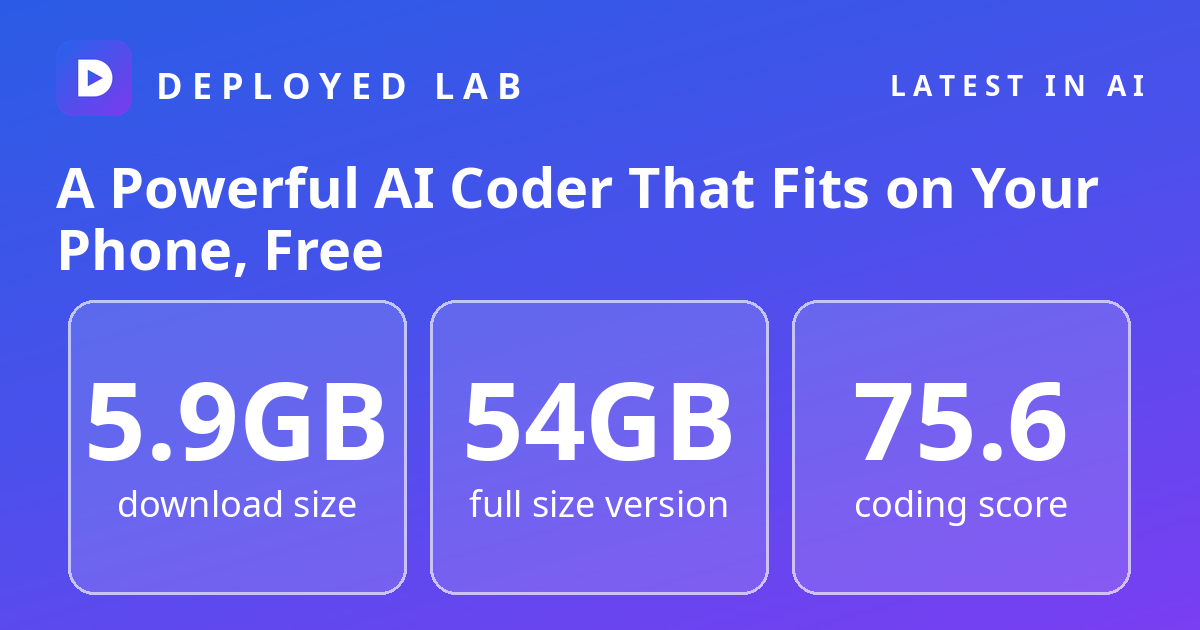
A coding AI with a 27 billion parameter brain usually lives in a data centre. PrismML's Ternary Bonsai 2.5 27B, released on November 24, 2026, fits in a 5.9 GB download and runs on your own machine. It is free, and because it runs locally, your code and your notes never have to leave your laptop.
The trick is compression. The model is based on Qwen3.8 27B, which takes about 54 GB at full precision. PrismML rebuilt every weight, the numbers the model thinks with, as a ternary value: each one is just minus one, zero, or one, about 1.7 bits instead of 16. That shrinks the model roughly nine times over, small enough for an everyday laptop, a single graphics card, or, through Apple's MLX software, a Mac, iPhone or iPad. On Windows and Linux machines it runs through llama.cpp on Nvidia and Intel chips.
Small only matters if it still works. In PrismML's own benchmark tests, Bonsai 2.5's SWE-bench Verified coding score rose from 60.8 for the previous release to 75.6, and its AppWorld tool-use score jumped from 51.2 to 90.5. Tool use is the unglamorous skill that decides whether an AI helper can actually open your files, run commands, and finish a multi-step job instead of just chatting about it. Those are the maker's own numbers, not independently verified, but the direction matches what the earlier Bonsai release retained against its full size base.
The download is free under the Apache 2.0 licence, which allows commercial use, and PrismML's own documentation puts the privacy point plainly: inference runs entirely on your machine, and nothing leaves it. There is no subscription, no per-question billing, and no account.
Why it matters
Most AI coding help today rents you a brain in someone else's data centre, and your code travels to it. A model this capable running on the device in front of you flips that: private projects, client code, and personal notes can get AI help without being uploaded anywhere, and the help keeps working on a plane or anywhere else with no connection. It will not replace the biggest cloud models on the hardest problems, and a 27B model still asks real work of a small machine. But the gap between "AI that lives in the cloud" and "AI that lives on your laptop" just got a lot narrower, and this one costs nothing to try.
Sources: PrismML via PRNewswire · 9to5Mac · The Decoder · PrismML documentation.
Want to understand the AI inside tools like this, in plain words and by doing? The full interactive Deployed Lab course, 11 chapters free, no signup, is at deployedlab.dev.