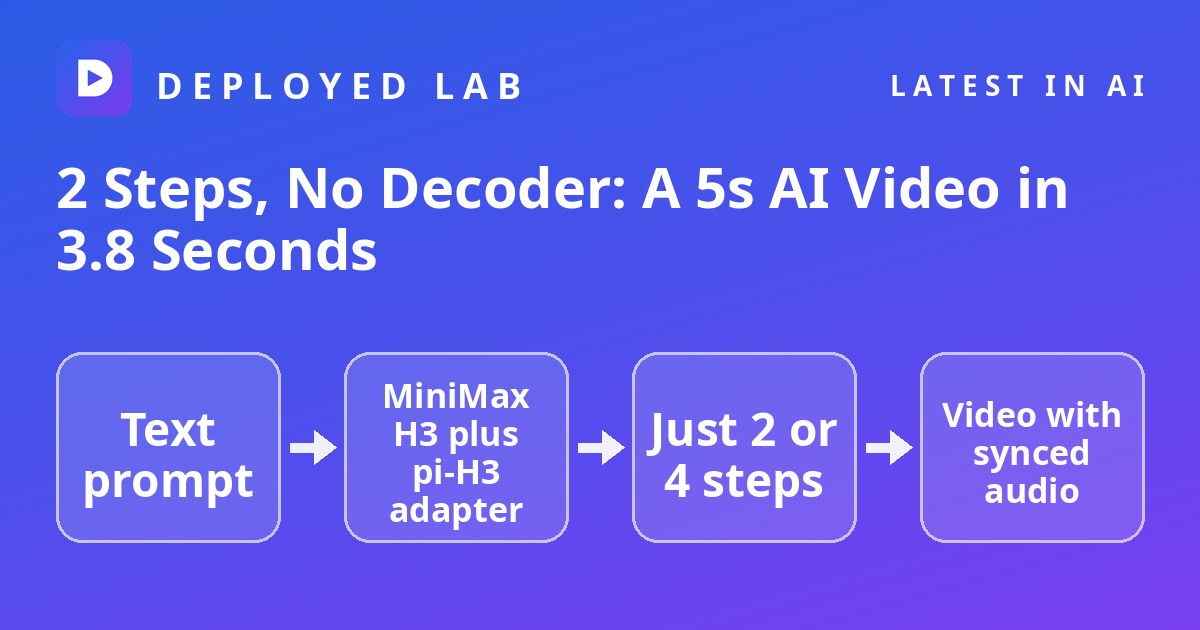
Video generation is slow because models build a clip in dozens of small steps, then hand the result to a separate decoder that turns it into pixels. pi-H3 1.0, released on November 21 by the Lakonik research project, attacks both halves of that cost: it distills MiniMax's H3 video model down to 2 or 4 steps, and at the final step it predicts the pixels directly, skipping the decoder altogether.
pi-H3 is not a new model. It is a set of four adapters for MiniMax H3, the video model MiniMax announced in July 2026, which generates video with synchronized audio. The adapters come from researchers at Stanford and Luma AI, led by Hansheng Chen, and combine two techniques: pi-Flow v2, a data-free distillation method that teaches the model to do in a few steps what it used to do in many, and DWD, short for Decoding Without a Decoder, which has the model output pixels at the last step instead of latent values that still need decoding. Four adapters ship: 2-step and 4-step versions, each in a DWD variant and a variant that keeps the VAE decoder, plus INT8 builds for ComfyUI. The team recommends the DWD versions.
The headline number is speed. In the authors' own measurements, a 5-second clip at 768p renders in 3.81 seconds at 2 steps on a single Nvidia B200, and 7.3 seconds at 4 steps. At 2 steps they claim 2.4 to 2.7 times faster than Sol-H3, MiniMax's official fast version. Two cautions: those benchmarks were measured with the earlier 0.9 release, and they are the authors' figures, not independent tests. Version 1.0 itself is about quality: the release notes say it improves fine-detail motion and makes the 2-step output more coherent than 0.9.
Why it matters
For engineers building with video models, steps are the bill. Every sampling step is a full pass through a very large model, so cutting dozens of steps to two is the difference between a clip that takes a minute and one that renders faster than it plays. Skipping the VAE decoder removes a second model from the serving path, which means less memory, fewer moving parts, and one less component to scale. It is the same pattern reshaping text models: distill a big teacher into a fast student, then delete everything the student no longer needs. The adapters are small next to the base model, but you still need H3 itself, which is tens of gigabytes, and the whole package ships under the MiniMax H3 Community License, so read the terms before commercial use.
Sources: the pi-H3 announcement on the project blog and the Lakonik/pi-H3 model card on Hugging Face.
Model choice, routing and cost control are a whole module of the course. The full interactive course, 11 chapters free, no signup, is at deployedlab.dev.