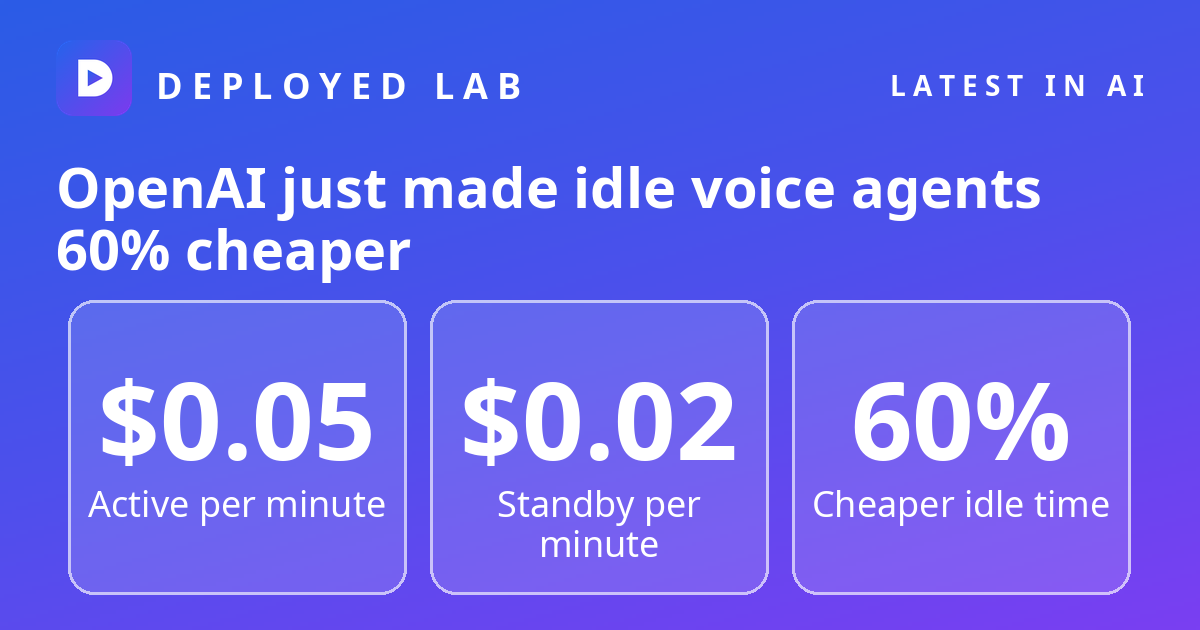
OpenAI has put GPT-Live-1.1 in its API, and the headline feature is not the voice itself but what happens when nobody is talking. A new standby mode bills idle voice time at 2 cents a minute, down from 5, which cuts the cost of silence by 60 percent.
GPT-Live-1.1 is OpenAI's full-duplex voice model, now available in the API under the model ID gpt-live-1.1. It listens while it speaks, so a caller can interrupt mid-sentence instead of waiting for a turn to end, and it hands reasoning and tool calls to a backend model the developer chooses. OpenAI says the new version speaks with more natural and consistent accents across languages, transcribes more accurately, and completes tasks more reliably than GPT-Live-1. The same model has powered voice in ChatGPT Plus and Pro since October 15. The API drop also adds seven new voice IDs, including voices tuned for Spanish-language speech, bringing the total to 38.
Standby applies to WebRTC sessions. Two session settings turn it on: wake_policy.type set to speech, so inference waits for voice activity, and idle_timeout_s, a whole number from 5 to 60 seconds. Once a call has been quiet for the timeout, the server pauses inference and emits a session.paused event; when someone speaks, it resumes with session.resumed. The connection, the session ID, and the conversation history are kept, so the caller notices nothing beyond a possibly slower first reply, since inference is cold-starting again. The microphone track has to stay open during standby. Standby works for both GPT-Live-1 and GPT-Live-1.1. One limit: it is WebRTC only, so phone calls over SIP and plain WebSocket connections still bill at the active rate.
Why it matters
For anyone building voice agents, the bill was dominated by silence. A support call, a tutoring session, or a phone agent mostly consists of the human reading, thinking, or walking away from the device, and every one of those quiet minutes used to cost the full 5 cents. At 2 cents, an hour of mostly idle call time costs $1.20 instead of $3.00, before the few active minutes are counted. Backend model and tool usage are billed separately on top, so standby does not change what the thinking costs, only what the waiting costs.
The trade-off to watch is latency on wake. OpenAI warns the first reply after a short utterance may be slower, so agents that need instant answers on every turn should test their own wake patterns before leaning on it. The other judgement call is whether your sessions are actually idle: an agent that talks non-stop gains nothing from standby, while one that waits on humans gains the most. Voice-agent pricing now rewards designing for pauses, not just for talk.
Sources: MarkTechPost's coverage and datastudios.org's report, both citing OpenAI's API changelog and pricing page.
Model choice, routing and cost control are a whole module of the course. The full interactive course, 11 chapters free, no signup, is at deployedlab.dev.