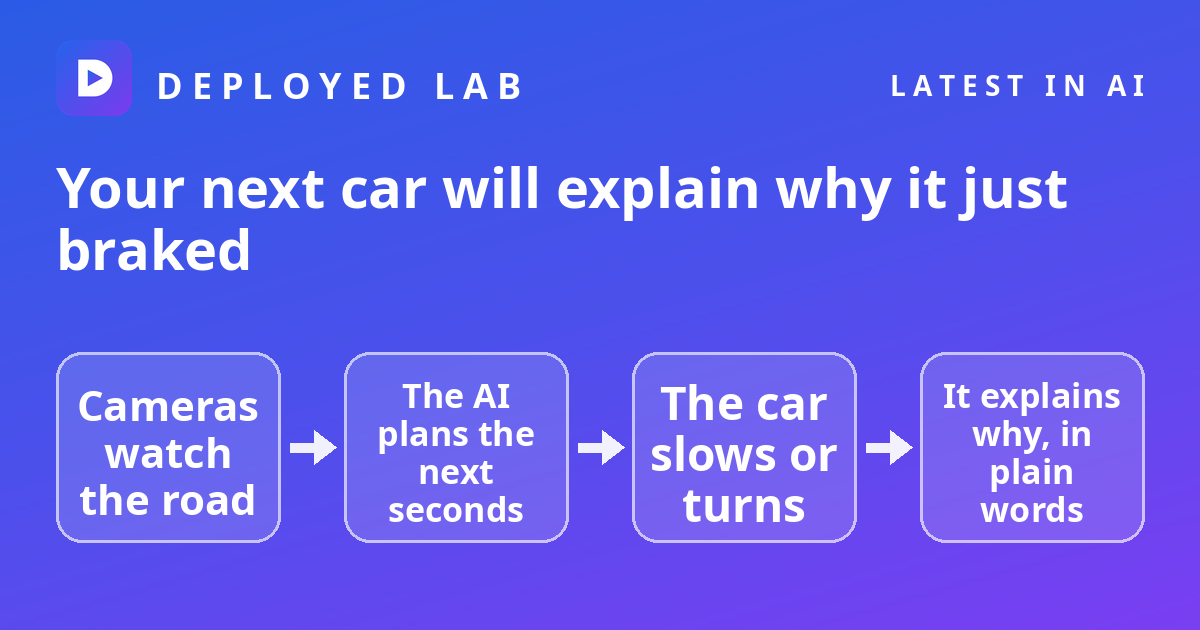
Your car brakes suddenly, and you have no idea why. That small jolt of panic is the trust problem at the heart of self-driving cars. NVIDIA's newest AI is built to remove it. Alpamayo 2 Edge does not just drive the car. It explains itself while it drives.
Released on November 10, 2026, Alpamayo 2 Edge is a compact AI model, about 2 billion parameters, deliberately small enough to run on a computer inside the car itself, NVIDIA's DRIVE AGX Thor, rather than in a distant data centre. It watches the road through six cameras, takes in the navigation instructions and the car's recent movement, and plans the next 6.4 seconds of driving. It refreshes that plan about ten times every second, so the plan is never more than a blink out of date.
The new part is the talking. Alongside the driving plan, the model produces a short, plain-language reason for what it is doing: a cyclist is about to cross ahead, a car is cutting in, a bus coming the other way needs room. NVIDIA calls this causal reasoning, and the model is selective about it. On a routine stretch of road it stays quiet and simply drives. It speaks up only when the situation calls for an explanation, which saves computing power for the moments that matter. NVIDIA has also released a companion tool, AlpaJudge, that grades whether an explanation actually matches what is happening in the scene.
Why it matters
People accept a human driver who calls out "braking, cyclist ahead" without a second thought. A silent machine gets no such grace. One unexplained brake is enough to make a passenger nervous, and enough nervous passengers can sink a whole technology, however safe the statistics say it is. A car that explains itself in one plain sentence behaves the way we already expect a good driver to behave, and that is what makes people willing to ride in one. The explanations help engineers too: when the car does something odd, the reason is written down, ready to be checked. Because NVIDIA published the model openly on Hugging Face, any carmaker or developer can build on it, not just NVIDIA's own partners. Two honest cautions: this is a model for developers today, not a feature in a car you can buy yet, and NVIDIA's driving results so far come from its own simulation testing, not independent road trials.
Sources: NVIDIA Alpamayo 2 Edge model card, Hugging Face · EVwire coverage.
Want to understand the AI inside cars like this one, in plain words and by doing? The full interactive Deployed Lab course, 11 chapters free, no signup, is at deployedlab.dev.