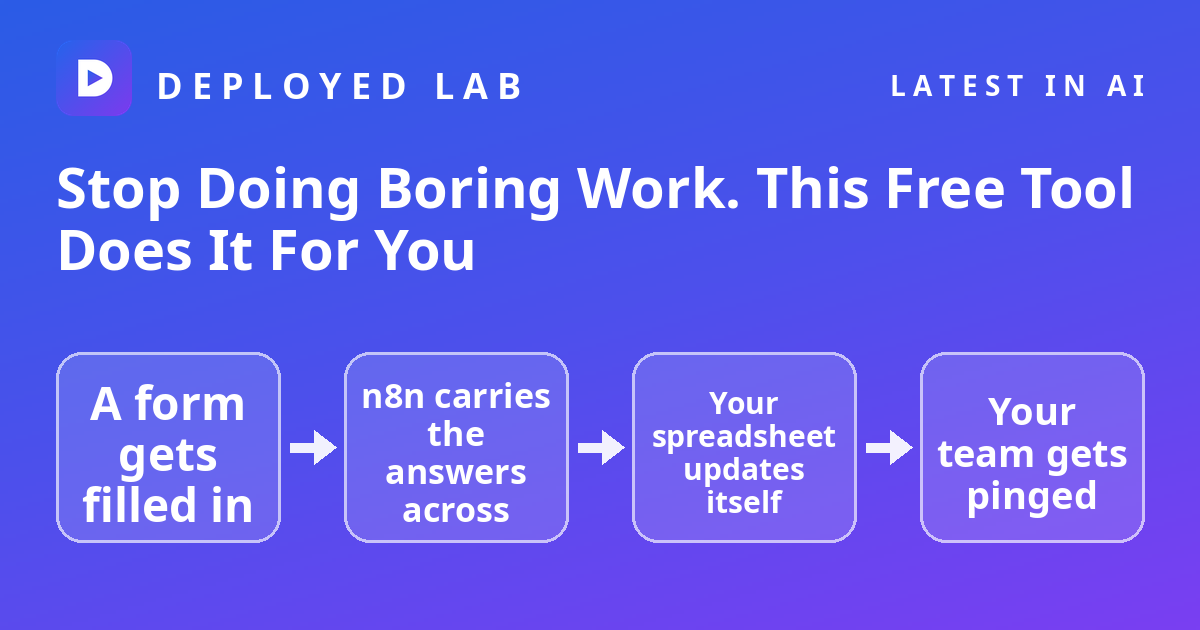
Copying numbers from one app into another is not real work, but it eats real hours. A free tool called n8n hands those chores to your computer. With over 211,000 stars on GitHub, it is one of the most loved automation tools in the world, and you can run it yourself for nothing.
Here is how it works. n8n shows your apps as boxes on a screen. You drag the boxes into a line and join them up: when this happens in one app, do that in another. It connects more than 400 apps and services, including Gmail, Google Sheets, and Slack, and the basics need no code at all. A typical starter automation takes about ten minutes to build: someone fills in your form, the answers land in your spreadsheet by themselves, your team gets a message, and a copy is filed away. The same pattern covers scheduled reports, reminder emails, moving data between tools, and notifications when something changes. If you later want more power, you can add your own code and even AI steps inside the same line, which is why bigger companies use it too.
There are two ways to run it. You can install it on your own computer for free, because the project is fair-code: the source is public and self-hosting is allowed under its Sustainable Use License. Or you can pay for the cloud version, which keeps it running all the time without you looking after a machine. Either way, your workflows and your data stay under your control, which is a big part of why the project keeps collecting stars and forks: 61,000 people have copied the code to build on it.
Why it matters
Most people meet automation as a feature buried inside expensive business software. n8n flips that: the tool itself is free, the skills transfer to almost any job, and the first win is small and concrete, one boring chore gone. Start with the task you dread most, the weekly report, the copied spreadsheet, the form you retype by hand. Build that one line, let it run for a week, and count the hours it hands back. That is the habit every AI workflow is built on: spot the repeated chore, describe it as steps, and let the machine do the steps.
Sources: the n8n repository on GitHub (stars, forks, license, and integration count read on November 23, 2026) and n8n.io.
Automations like this are chains of models, tools, and triggers, the same pieces the course teaches hands on. The full interactive course, 11 chapters free, no signup, is at deployedlab.dev.