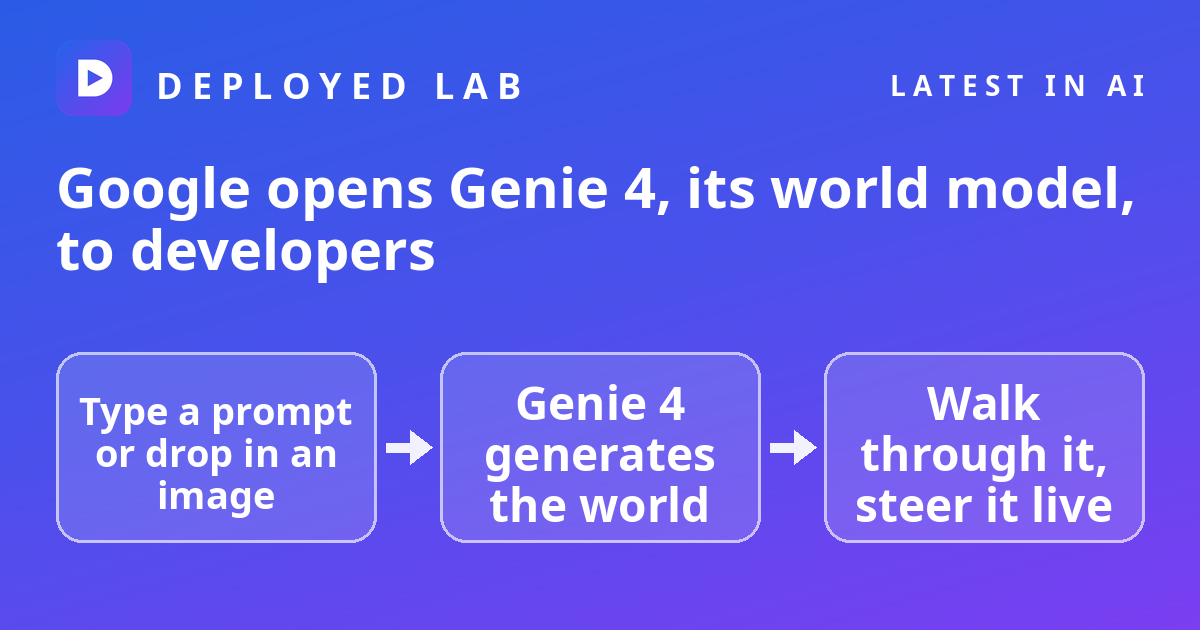
Google opened Genie 4 to developers on November 19, and the interesting thing about it is what you build with: not text or images, but a place. Genie 4 is a world model, and it is now available through the Gemini API and Google AI Studio, a day after it reached Google AI Ultra subscribers inside Project Genie.
You start with a text prompt, a reference image, or both. Genie 4 generates a continuous world around that seed and renders it in real time: 720p video at 24 frames a second, with native audio that matches the scene, from ambient sound and sound effects to character dialogue. You steer it while it runs, with keyboard controls or new text prompts, and it redraws the world as you go. Google calls it its first world model for developers to build with, and it arrives as model code models/genie-4 on the Interactions API.
Access needs a paid-tier Gemini API key. Sessions stream over WebRTC for browser apps or WebSockets for server code, with single-session ephemeral tokens keeping the main API key off the client. Pricing is about 10 cents a second of streamed output, stereo audio included, which Google breaks down as $1.50 per million input tokens, $9 per million text output tokens and $17.50 per million video output tokens. Sessions cap at 120 seconds and cannot be resumed, so a world lasts two minutes and then it is gone. Every output carries an imperceptible SynthID watermark.
Genie 4 was first announced on October 27 as a research preview for trusted testers, the first in the Genie line to generate sound alongside the picture. The November 18 rollout put it in Project Genie for eligible AI Ultra subscribers, with AI Pro members on a waitlist. The November 19 developer release is the step that matters for builders: the same model, now callable with an API key.
Why it matters
For an AI engineer, the shift is that a world model is now an API call, not a research demo. Google's own suggested uses are prototyping interactive experiences, visualizing spatial designs, and training robotics and AI agents. A game level, a floor plan you can walk through, or a training ground for a robot can now start as a prompt, and the cost of trying is measured in seconds, not in a 3D pipeline. The constraint to design around is the session: 120 seconds, no resume, no persistent scene. That makes Genie 4 a draft mode for worlds, not a place to live in, and the skill is knowing which ideas fit in two minutes and which need a real engine behind them.
Sources: Google's announcement and TestingCatalog's coverage.
Model choice, routing and cost control are a whole module of the course. The full interactive course, 11 chapters free, no signup, is at deployedlab.dev.