Google DeepMind released Gemini 4 Neon on November 18, and the interesting thing about it is where it sits: not at the top of the range, but in the middle. Neon slots between Hydrogen, the small and fast model, and Carbon, the flagship, and it is built for the trade-off production systems actually face: good answers, quickly, at a price you can run all day.
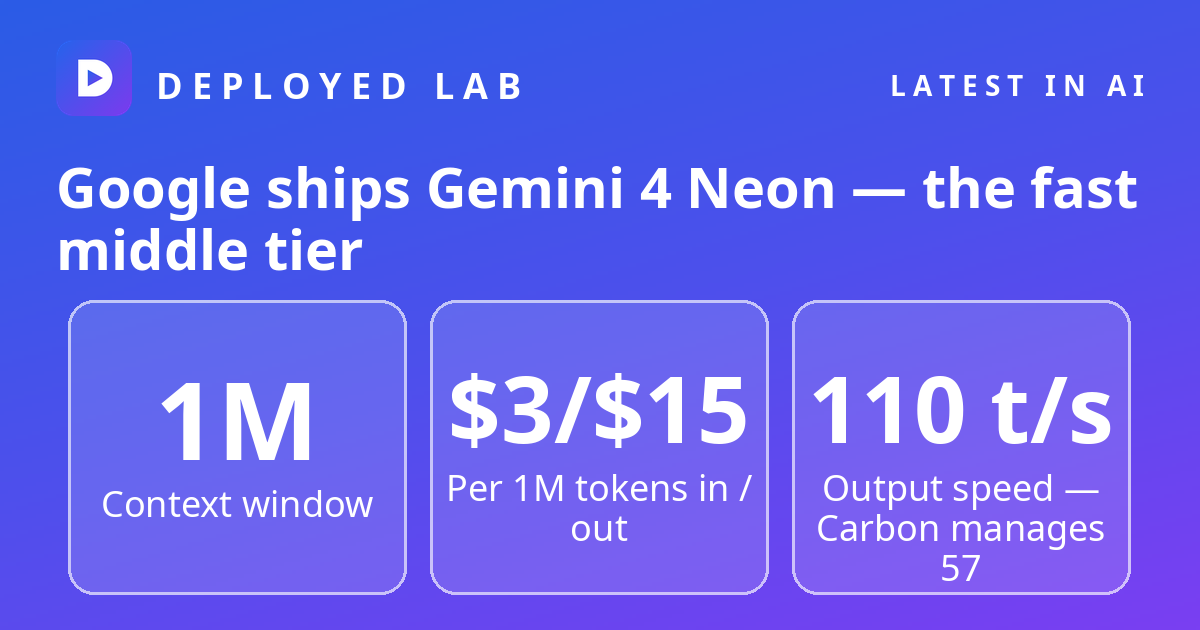
The specification is generous for a mid-tier model. The context window holds one million tokens, there are four thinking levels so you can dial how much reasoning a request gets, and the price is $3 per million input tokens and $15 per million output tokens.
The independent numbers are what make it news. Artificial Analysis, which benchmarks models it does not sell, puts Neon third on its Intelligence Index with a score of 61, and first on its Coding Agent Index. It is also quick: about 110 tokens a second of output, against 57 for Carbon, nearly twice the flagship's speed, at a mid-tier price.
Why it matters
Most production agents do not fail because the model is not smart enough. They fail on latency and cost: a loop that calls the model twenty times is twenty times the flagship's bill and twenty times its waiting. A model that tests near the top of independent rankings, answers twice as fast as the flagship and costs less per token changes what you can afford to build: longer agent loops, more retries, bigger context, features that would have stayed demo-only.
The four thinking levels matter just as much. Reasoning effort becomes a knob you turn per request, cheap and shallow for easy calls, deep for the hard ones, instead of a fixed tax on every call. Knowing when to turn that knob is a core engineering skill, and it is exactly the kind of judgement the flagship-for-everything habit skips.
Sources: Google's announcement and The Decoder's coverage.
Model choice, speed and cost control are a whole module of the course. The full interactive course, 11 chapters free, no signup, is at deployedlab.dev.