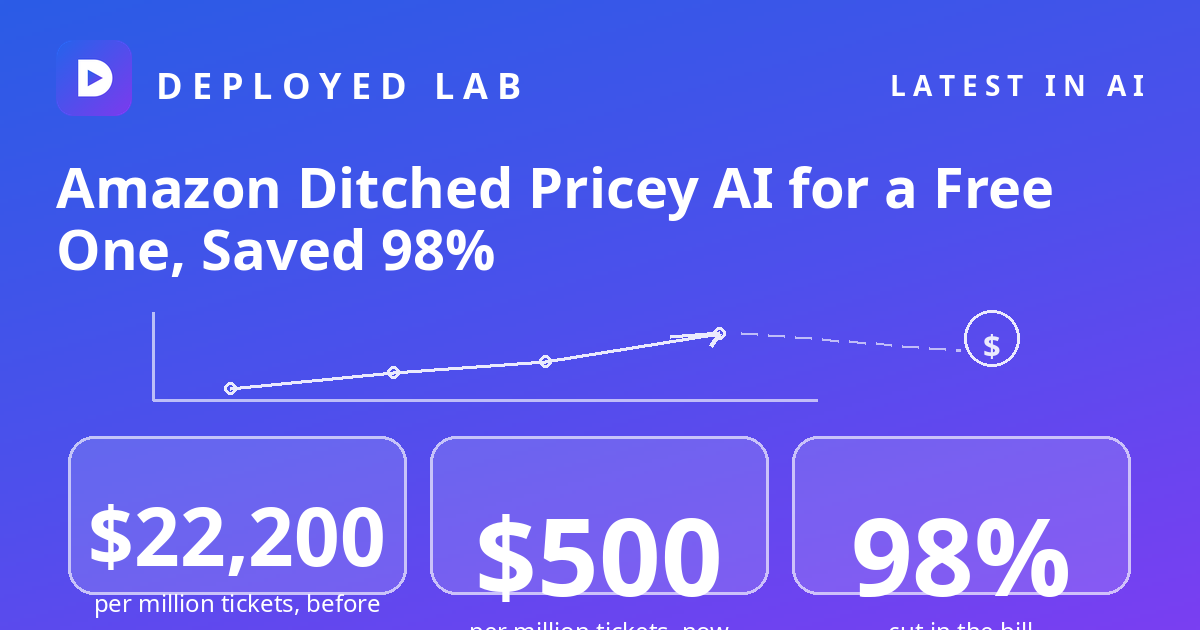
Amazon was paying a top writing AI to do a multiple choice job. Inside one of the world's biggest internal ticketing systems, every ticket simply needed one of 20 labels. Two Amazon engineers swapped the big model for a free one that cannot write a single sentence, and the labeling bill fell by 98 percent.
The old setup used Claude Sonnet 4.6, run through Amazon Bedrock, with a long system prompt on every ticket. Sonnet read the ticket, reasoned against the full label catalog, and wrote its answer out as JSON: 6,554 input tokens and 170 output tokens per ticket, at about $0.0222 a ticket. That is roughly $22,200 for every million tickets, and each answer took about 4.2 seconds.
The replacement is Strands Decider, a decision model built by AWS's Strands Agents team and released as free open source. A decision model cannot generate text at all. You hand it some state, a question, and a set of options, and it returns a probability for each option plus a confidence score: it selects among candidate answers instead of writing one. The version Amazon runs, Strands Decider E4B, is built on Google's open Gemma 4 model. It uses 2,009 input tokens and exactly one output token per ticket, answers in about 897 ms, and costs about $0.0005 a ticket, roughly $500 per million, at published list prices. After the engineers tuned how confident the model had to be before applying a label, it beat the production Sonnet setup on a separate set of their own tickets. Amazon says the change will save millions of dollars of token costs in a year.
Two honest caveats. The figures are Amazon's own, measured at published list prices; an independent check by SpliceOps recomputed both bills from the published token counts and confirmed the arithmetic, while noting that part of the saving came from the much shorter prompt the small model forced, because the 20 label descriptions had to be rewritten as one or two sentence rules to fit its window. And the trick only works because the job is a closed choice from a fixed catalog. If a label needs an explanation, the catalog changes every week, or the context runs long, the engineers themselves say a decision model probably cannot replace the big model.
Why it matters
A lot of business AI spend is classification wearing a chatbot's clothes: routing a message, tagging a document, sorting a queue, approving or flagging a request. Those jobs never needed essays, but companies pay essay prices for them because the big general model was the easy first choice. Amazon's swap is a reminder to audit your own AI bill for pick-from-a-list work. If the answer always comes from a fixed set of options and nobody reads an explanation, a small free picker can be about 44 times cheaper, and faster too.
Sources: Strands Agents, "Amazon saves millions by replacing Sonnet 4.6 with Strands Decider" · SpliceOps, "Amazon's 44 times cheaper AI bill, checked".
Want to understand the AI inside tools like this, in plain words and by doing? The full interactive Deployed Lab course, 11 chapters free, no signup, is at deployedlab.dev.