Five stories, one day: data centers in orbit, one meter for your ChatGPT usage, a search engine that travels in time, a brain implant trial, and a password nobody changed. Here is the short version, with the numbers that matter.
1. SpaceX can put up to 1 million AI data centers in orbit
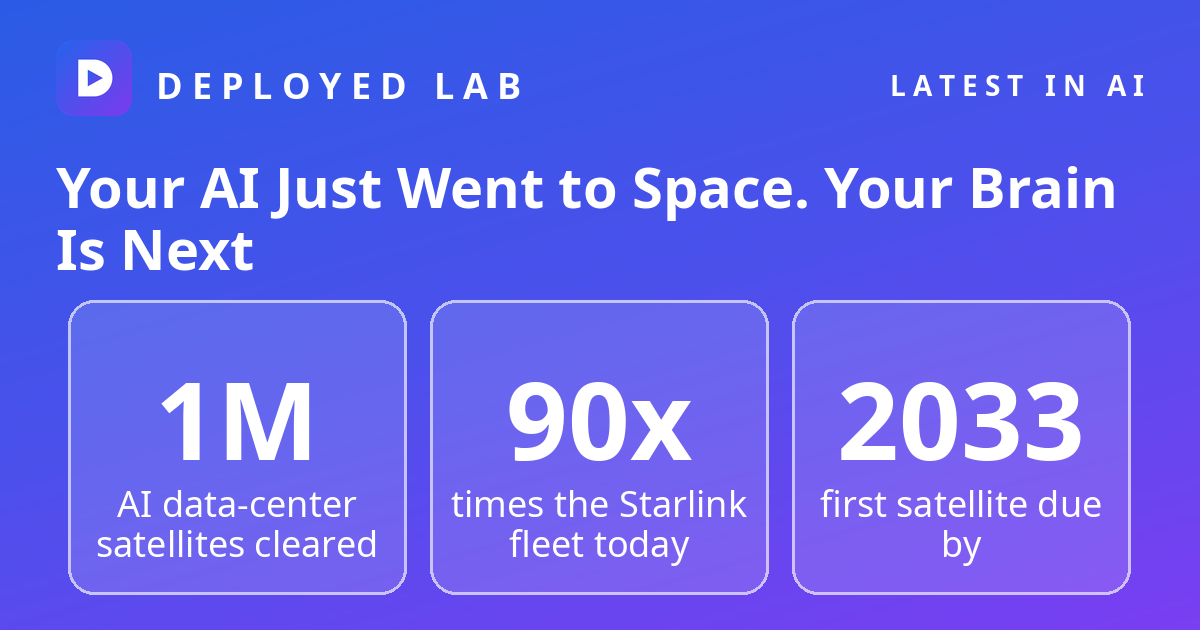
The US Federal Communications Commission has authorized SpaceX to deploy a constellation of up to 1 million satellites, called Starmind, that would work as data centers in space, processing AI workloads and beaming the results back to Earth. For scale, SpaceX's Starlink broadband fleet, already the largest in orbit, is a little over 11,000 satellites, so the clearance is roughly 90 times that. The license is a starting gun, not a launch schedule: SpaceX must get its first operational satellite up by November 2033, 100,000 by 2035, and the full constellation by 2040, and the company still has other regulatory hurdles to clear. Astronomers and rival operators objected over debris and congestion, and scientists quoted in coverage are skeptical the full million will ever fly.
2. ChatGPT is putting Chat, Work and Codex on one meter
OpenAI's help pages say that from December, the Plus, Pro and Business plans get a single usage allowance, counted in tokens, shared across ChatGPT and Codex as the agent features of Work move into the main ChatGPT window. Until now, everyday chat had its own limits while Work and Codex shared another pot; from December, the heavier thinking all draws from the same balance, and how fast you spend it depends on the model and the job. One thing stays free: conversations with the Instant models do not draw from the allowance at all, and OpenAI says it expects most people will not hit the limit more often than they do today. Your remaining balance and reset times will show in Settings, under Usage.
3. Perplexity's Time Machine searches the web as it was
Perplexity launched Time Machine on November 25 for its Search and Context APIs, the tools developers and AI agents use to look things up. Add a cutoff date to a search and the results come only from the copies of pages Perplexity saved at or before that moment, up to 365 days back, instead of the live web. The point is hindsight: today's web already knows how an election or an earnings call turned out, so an AI asked to judge a past question cheats without meaning to. With a cutoff, it has to answer with only what was known then, which makes its answers fairly testable against what happened next. It costs the same as a normal call, $5 per 1,000 searches, with no surcharge for searching the past.
4. Neuralink's brain implant gets its first full US trial
Neuralink announced on November 25 that the FDA has approved the LINK Pivotal Study, which the company describes as the first pivotal trial of an implantable brain-computer interface in the United States. Earlier studies were small safety tests; a pivotal trial is the bigger, formal kind whose results can support an eventual application to sell the device. The study is for adults with severe paralysis caused by ALS, and it will test whether participants can control digital devices by thought alone, alongside long-term safety. Enrollment is open now. Two honest caveats: approval covers the trial, not the product, which remains investigational, and the company has not published how many people the study will take.
5. A default password left 152,092 AI requests readable
Phala, a company that runs AI models on hardware meant to keep customer data sealed, published its final incident report on November 23. An experimental deployment of the DeepSeek model, taking live traffic from the router OpenRouter before production controls were in place, kept the default administrator password on its monitoring service. An attacker logged in with it, reached the host controls, and planted software that read the requests flowing through: 152,092 requests reached the deployment between October 21 and November 1, and Phala counts them as at risk. OpenRouter itself was not breached, but on November 22 it dropped three providers and removed 125 model listings from its zero data retention program, the setting that promises your prompts are not stored. The lesson is embarrassingly basic: change default passwords, especially on anything an AI sends your words to.
Why it matters
The day's theme is scale meeting trust. The industry is planning compute by the million satellites and metering your usage by the token, while the weakest link in the whole chain turned out to be a password that shipped with the software. And in the middle of it, two quieter shifts matter for ordinary people: search that can be pinned to a date makes AI answers easier to check, and a brain implant moving from safety tests to a pivotal trial is the step that decides whether a technology becomes a product.
Sources: Reuters on the FCC authorization · TechCrunch on the Starmind approval · Sulat News on the shared ChatGPT meter · Softonic on the shared usage limits · Perplexity on Time Machine · Emergent on the Time Machine launch · Neuralink on the LINK Pivotal Study · Engadget on the FDA approval · AI.info on the Phala incident report · HendryAdrian on the Dragos findings.
Want to understand the AI behind stories like these, in plain words and by doing? The full interactive Deployed Lab course, 67 chapters free, no signup, is at deployedlab.dev.